Lynda Slattery
14 May 2026 · 7 min read · 118 views
The $15K Mistake: Why Manual Customer Onboarding Is Killing Profits
67% of small businesses waste 20+ hours weekly on manual onboarding tasks. Manual processes cost $15K annually in errors, delay customer value by 45%, and cap growth. Smart automation delivers 300-500% ROI.
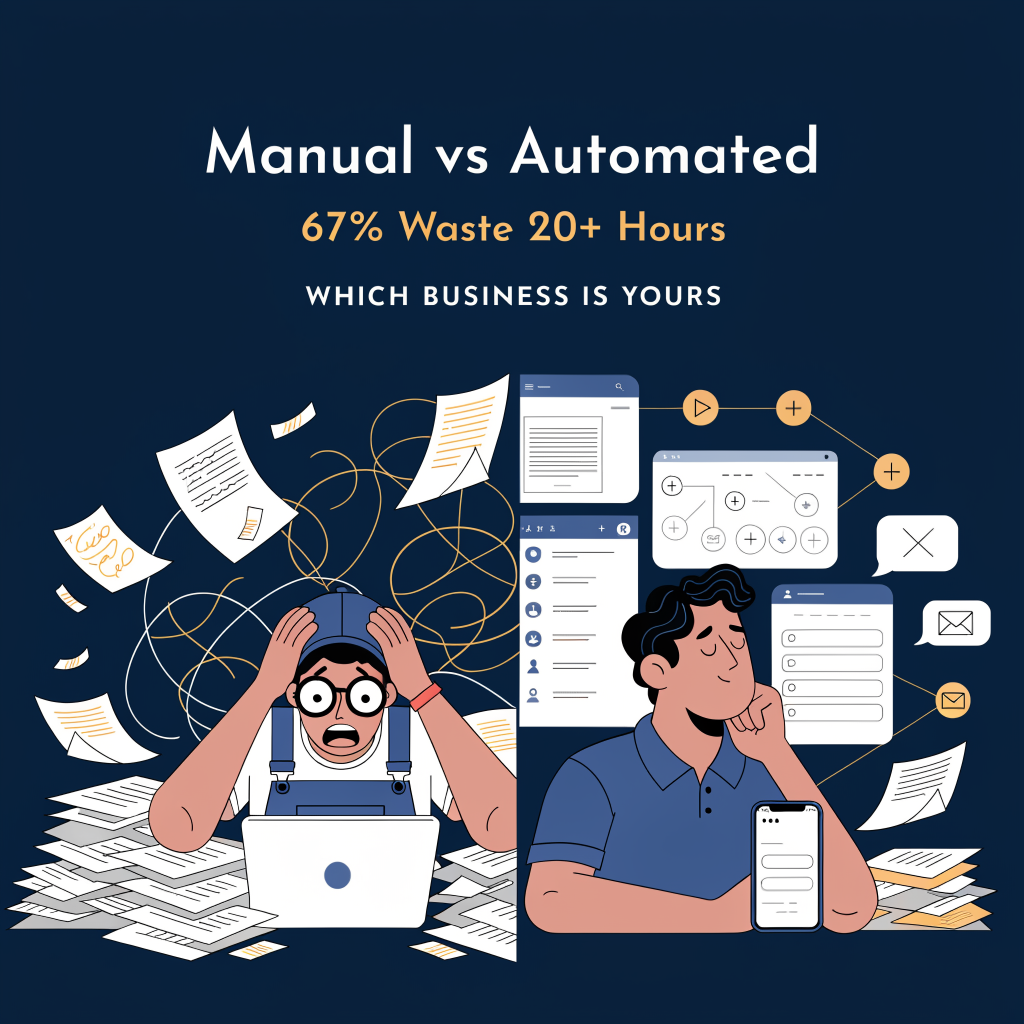
What if I told you that 67% of small businesses are literally watching money drain out of their bank accounts every month because they're still onboarding customers with spreadsheets and sticky notes?
It sounds absurd, but it's happening right now in businesses across the country.
While competitors streamline operations with automated workflows, these businesses are trapped in a cycle of manual processes that bleed time, money, and customers. The cost? More devastating than most business owners realize.
The Hidden Cost Crisis: Why Manual Processes Are Bleeding Your Profits
Sarah runs a successful marketing consultancy. Every Monday morning, she faces the same nightmare: a pile of new client paperwork, scattered emails with incomplete information, and the sinking realization that she'll spend her entire week playing catch-up instead of growing her business.
She's not alone. According to the Small Business Administration's Technology Survey, 67% of small businesses report spending more than 20 hours per week on administrative tasks that could be automated.
That's over half a full-time position dedicated to tasks that technology could handle in minutes.
But here's where it gets truly painful: Manual processes don't just waste time—they actively cost money. Gartner's Data Quality Market Survey reveals that manual data entry errors cost small businesses an average of $15,000 annually in lost revenue and correction costs.
Think about that for a moment. $15,000. That's not just the cost of fixing mistakes—it's the revenue lost when customers get frustrated with delays, incorrect information, and unprofessional experiences.
Sarah discovered this the hard way when a data entry error led to launching the wrong campaign for a major client. The correction process took 40 hours, cost $8,000 in rush fees, and nearly ended a $50,000 annual relationship.
The opportunity cost is even more devastating. While you're buried in manual tasks, competitors are out there acquiring new customers, developing innovative services, and scaling their operations. The SCORE Small Business Growth Challenges Report found that 73% of small business owners report that administrative tasks prevent them from focusing on business growth activities.
The Customer Experience Catastrophe: How Slow Onboarding Kills Retention
Today's customers don't just want fast service—they demand it. They've been conditioned by Amazon's one-click ordering, Netflix's instant streaming, and Uber's seamless booking.
When your onboarding process involves multiple emails, paper forms, and week-long delays, you're not just inconveniencing customers—you're actively damaging your brand.
The McKinsey Global Institute's Business Process Automation Report found that small businesses using manual processes take 45% longer to onboard new customers compared to those using automation. This delay directly impacts time-to-value for customers and influences their decision to stay with your business long-term.
But speed isn't the only issue—it's consistency. The Salesforce State of the Connected Customer Report reveals that 86% of customers expect companies to be proactive in their communications during onboarding.
Manual processes make proactive communication nearly impossible. You're too busy firefighting errors and chasing missing information to provide the seamless experience customers expect.
Consider Tom's accounting firm. His manual onboarding process averaged 14 days and involved six different touchpoints. New clients frequently complained about the lack of updates, unclear next steps, and feeling "forgotten" in the system. His customer satisfaction scores reflected this frustration, sitting 30% below industry averages.
The retention impact is measurable. Deloitte's Customer Experience Study shows that companies with automated onboarding see 18% higher customer satisfaction scores and 12% better retention rates.
When you consider that acquiring a new customer costs five times more than retaining an existing one, those retention percentages translate to massive profit differences.
The Scaling Impossibility: Why Manual Processes Cap Your Growth
Here's the brutal truth about manual customer onboarding: it creates a linear relationship between growth and workload that will eventually break your business.
Every new customer requires the same manual effort. Double your customers, double your administrative workload. Triple your customers, triple the chaos.
Mark learned this lesson when his software training business grew from 50 to 200 clients in six months. What should have been a celebration turned into a nightmare. His team was working 60-hour weeks just to keep up with onboarding tasks. Quality suffered, mistakes multiplied, and his best employees started looking for other opportunities.
The math is unforgiving: If each customer requires 8 hours of manual onboarding work, and you want to serve 100 new customers per month, you need 800 hours of administrative work monthly. That's 20 full-time positions dedicated solely to onboarding.
As volume increases, quality degrades. Rushed processes lead to more errors. Overworked staff make careless mistakes. The very growth you've worked so hard to achieve becomes the thing that threatens to destroy your business.
Staff burnout isn't just a human resources issue—it's a profit killer. When experienced employees leave because they're tired of repetitive manual tasks, you lose institutional knowledge, face recruitment costs, and invest time training replacements who will likely repeat the same cycle.
This is why so many successful small businesses hit a growth ceiling around 200-300 customers. They simply can't scale their manual processes fast enough to support continued growth without proportionally increasing their workforce.
The 300% ROI Solution: How Smart Businesses Are Automating Their Way to Profit
While some businesses struggle with manual processes, others have discovered the transformational power of automated workflows.
The results are remarkable. The Harvard Business Review's Automation ROI Study found that businesses that automate customer onboarding report ROI of 300-500% within the first year.
Let's break down why these returns are so impressive:
Time Savings: Tasks that previously took hours now complete in minutes. Information flows automatically between systems. Status updates send themselves. Follow-ups happen on schedule without human intervention.
Error Reduction: Automated systems don't have bad days, don't get distracted, and don't make transcription errors. Data flows cleanly from intake forms to project management systems to billing platforms.
Scalability Without Proportional Growth: The same automated system that handles 50 customers can handle 500 with minimal additional resources.
Consider Lisa's digital marketing agency. After implementing automated workflows, she reduced her onboarding time from 12 hours per client to 45 minutes. Her team's satisfaction scores improved by 40% because they could focus on strategic work instead of data entry.
The financial impact was immediate: With 20 hours per week freed up from manual tasks, Lisa's team could serve 30% more clients without hiring additional staff. Her annual revenue increased by $180,000 while her operational costs remained flat.
But the real magic happens when automation creates consistency. Every customer receives the same professional experience. No one falls through the cracks. Communications happen on schedule. Documents are always current and accessible.
This consistency builds trust, which builds retention, which builds profits.
Modern small business automation doesn't require massive IT investments or months of implementation. Smart AI websites and specialized small business automation tools can transform your onboarding process in days, not months.
The businesses that embrace this technology aren't just saving time—they're gaining a competitive advantage that compounds every month. While their competitors struggle with manual processes, they're scaling efficiently, delighting customers, and focusing their human talent on high-value activities that drive growth.
The question isn't whether you can afford to automate your customer onboarding process. The question is whether you can afford not to.
Every month you delay is another month of lost productivity, frustrated customers, and missed growth opportunities. The businesses that act now will be the ones dominating their markets while their manual-process competitors wonder what happened.